

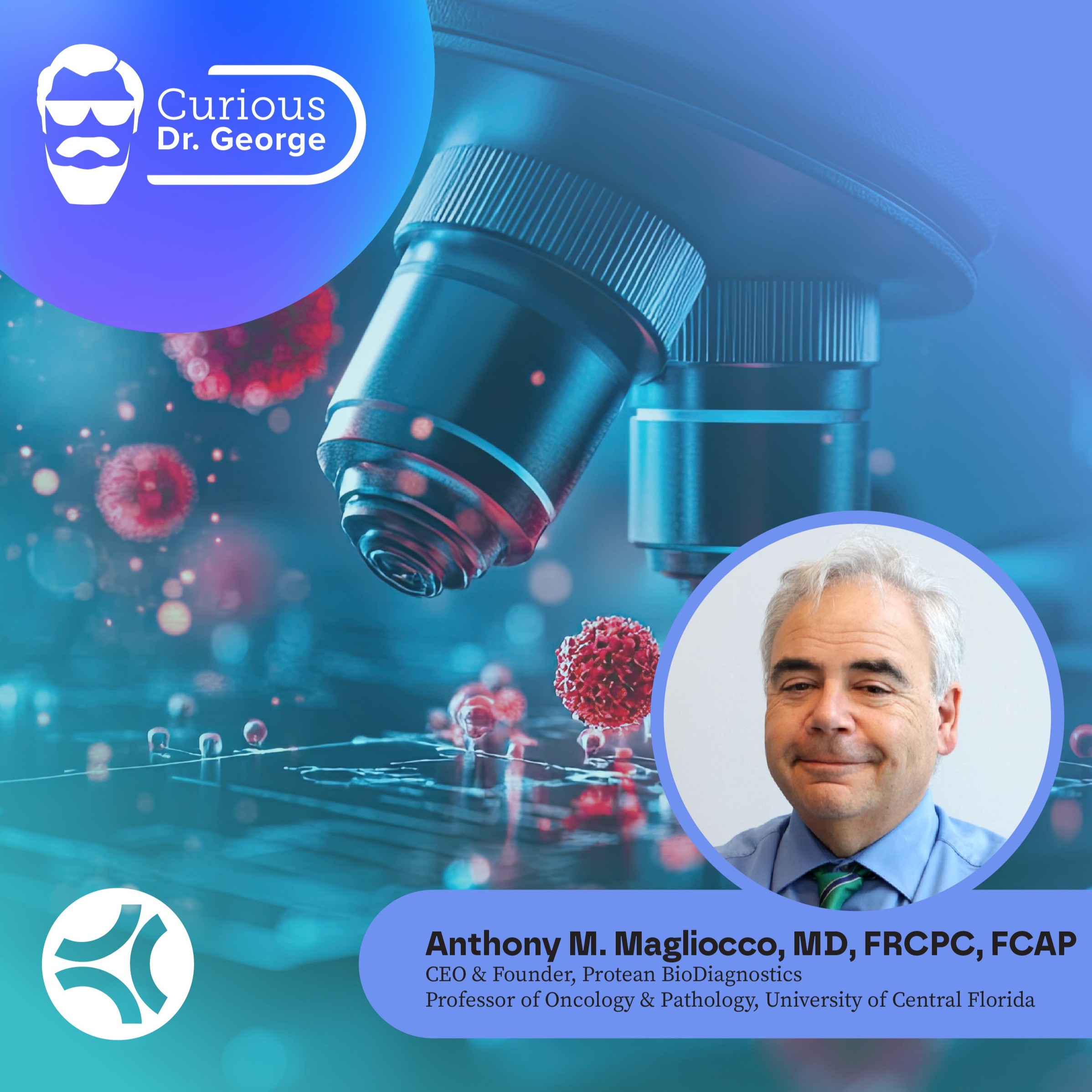

Dr. Magliocco is a professor of oncology and pathology at the University of Central Florida and CEO and founder of Protean BioDiagnostics, which offers cancer diagnostic testing services.
Curious Dr. George: For the past 20 years, precision oncology using genomics to guide cancer care has led to many advances in understanding and some therapeutic successes—but much is still to be done. Following the concept of sensitivity testing to identify the best antibiotic for treating difficult bacterial infections, research in oncology is now emphasizing what could be called “tumor sensitivity” to anticancer drugs. Both the National Cancer Institute and the American Society of Clinical Oncology have issued statements outlining their support for this field, known as functional precision medicine.
Obviously, in order to provide functional precision medicine to a patient, a pathologist must make the patient’s tissue available for testing to identify the best treatment options. What other roles do you believe that pathologists shouldplay this early in the evolution of this new approach to cancer therapy?
Anthony M. Magliocco, MD, FRCPC, FCAP: The re-emergence of functional precision medicine is timely and welcome, particularly given the rapid expansion of treatment options and therapeutic modalities. The concept itself is not new. For decades, investigators have tried to develop oncology equivalents of microbiology’s culture and sensitivity testing. The difficulty is that cancers are far more complex.
Cancers are not simple collections of malignant cells. They are dynamic living systems—closer to mini-organs—composed of tumor cells, stroma, vasculature, and immune elements. These ecosystems grow, adapt, and evolve. When treatment is applied, they respond and change.
One fundamental challenge is that cancer tissue is immediately altered once removed from the body. Temperature shifts, loss of host perfusion, disruption of immune context, and changes in nutrients, hormones, and gas exchange all place stress on the sample. As a result, the cells being tested may no longer faithfully represent the tumor as it exists in the patient, which can limit the reliability of functional readouts.
Pathologists will play a central role as this field develops. That role includes more than simply making tissue available. It includes coordinating appropriate tissue selection and handling, ensuring specimen quality, and interpreting functional results in the broader clinical and pathologic context for treating oncologists. Pathologists also serve as educators—identifying cases in tumor boards where functional testing may add meaningful decision support.
Functional precision medicine remains a young field. It will face substantial challenges in regulation, standardization, and scale. Because it depends on viable cells, logistics are nontrivial. Tumor heterogeneity and the dynamic nature of cancer further mean that results from a single isolate may not fully represent the disease.
My colleagues and I expect to elaborate on these thoughts as the field develops.
Dr. Magliocco can be reached at magliocco@proteanbiodx.com
.png)

.jpg)


